
Fiction for Patrons: Extract from A Life Before: Introducing Rosy
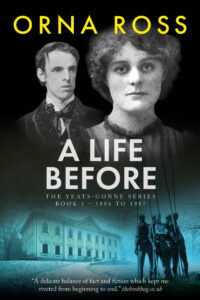
This is the first chapter of A Life Before, in which the narrator Rosy Cross introduces herself and touches on the connections between herself and the subjects of her story, the Irish poet and mage, WB Yeats, and the heiress turned revolutionary Maud Gonne, and her daughter, Iseult.
 “Always remember, a grá,” Nana used to say, as if foretelling that one day I’d find myself among the murderers and ne'er-do-wells, “everyone arrives here helpless and crying after mother's milk. And no matter how black-hearted a person turns, they're still yoked to the beating breast of the world. Yes, and their mother has hope for them yet.”
Nana loved motto talk like that, and fairy-tale scenarios, and pishogue advice, and most of all, she loved telling stories. Fadó, fadó, she’d begin, her Irish way of saying: Once upon a time. “Fadó, fadó, long ago, when birds made nests in old men’s beards, there was a girl… there was a boy… there was a creature…” And off she’d set, taking you on a new tale about the doings of her god-like people, when they were giants in their legendary lands. Or what they were up to now, in the small and silent forms they took with us here in our own fields and woods, half-hidden.
We were country people and our bit of land was in the County of Carlow, a village called Graiguenaspiddogue. It’s only claim to fame was the length of its name. A mouthful of tongue-trippage, right enough, when said the English way—Graig-na-spid-ohg—but in the Irish language, simple and lovely. Graig na Spideóg, the hamlet of the robins.
“What a sorrow,” Nana would say, “how the English military took our meanings from us as they mapped out their miles.” Nana was no admirer of the English. “They knocked our sounds senseless into their language, then hardened their miscreations into their fancy new signposts.”
The signposts were not new to me. They’d always been there, marking the start and end of our village. And as well they did, for Graiguenaspiddogue, the smallest of settlements in the second-smallest county of Ireland, was a place of indistinct edges and indefinite boundaries. Without those signposts that Nan despised, we wouldn’t have known where the place commenced or completed.
We lived in the cottage the English had mapped as House 14, a seven-minute walk away from Nana, grandfather Dan, and their children Uncle Matty and Martin, Auntie Breda and Bernadette, at House 23. Not that anyone in Graiguenaspiddogue thought in numbers. Our houses were named for the families who occupied them, so our cottage was Cross’s, Nana’s was Cullens’s, and our friends’ house, the blacksmith’s dwelling and forge, was O’Neill’s. Even the big house was named for the family who lived there: Rochford Hall.
Graiguenaspiddogue was no more than a string of poor housing lining either side of a mud road, with great gaps between many of the dwellings, and many pitched at odd angles to their neighbors. We had neither church nor public house, never mind a barracks or dispensary. We had no village hall or public house to gather in, only O’Neill’s forge at the crossroads, where everyone went at one time or another to share talk with my friend’s father, Mick O’Neill, a man who’d talk the bark off a tree. There was where we’d dance and play music, too, when the weather allowed. Which, it being Ireland, was none too often.
Not a lot to beguile, you might think and you wouldn’t be wrong, but Nana somehow made it all magical. Telling us how the robins that gave our place its name earned their red breasts, flying too close to the fires of purgatory as they ushered the souls of the dead into the afterlife. Pointing up the sky and the clouds, turning a swirl of vapor into a white horse, or the face of a sprite. Noting always the changes of hue between day and night. “Look Rosy,” she'd say to me, pointing to rose-coloured skies after dawn, or at dusk, “you're lighting up the skies again”. By night, she’d invite you to look at the stars, see how the more you looked, the more of them you saw, until they swarmed into your heart, and you could feel the beating pulse of the other world, the one she was always talking about, the one that breathes close to this one.
For as long as she lived, that woman concocted wonderments, then she died and the magic went out of my world. It took the great tragedy of Graignaspiddogue, the killing of Lily O’Neill, for me to get it back.
That’s what I want to tell you about in this story, and I’ll have to take you a long way back if you’re to understand how such a thing could happen to the likes of us, in the Ireland of our day.
This is a story about a magician-turned-poet, an heiress-turned-revolutionary, and a girl gone wrong. All three were famous throughout Ireland, though poor Lily was given another name to wear in her infamy. Honor Bright. You may have heard of her? And you’ve surely heard of the poet WB Yeats, if not his mother-and-daughter muses, Maud and Iseult Gonne.
I’m telling you about Nana first, for she was the first of our tribe and the one who gave me the wish and the wherewithal to tell the tale. Nana had the storytelling knack and she passed it on. All the women of her house—my mother and my aunts and my cousins as well as m’self—could spin a yarn, though none of us was ever the seanchaí she was. When my turn came, I had a benefit not given to my foremothers. I could read and write, and there was nothing I liked to do more. Which is how the telling of what befell us has fallen to me.
So step with me now, back into the old century to the year of 1885. The year WB Yeats began his career as a published writer and launched his first society for the exploration of the occult. The year Maud Gonne danced with a prince at her coming-out ball and saw her first eviction. The year the Irish started to lead the charge in the English parliament, with Miss Parnell setting up the Land League huts to help the destitute evicted, and her brother accepting overtures from prime minister Gladstone. 1885. And the year my mother, Agatha, first laid her sights on my father.
You’ll need to know something of my people and my own name and number if you’re to trust me with this tale, I suppose, and fair enough. However, like Lily O’Neill, I need a second name for this work so I’ve decided you can call me Rosy Cross. It’s a name that suits me a hundred ways round, for I had a cross mother and three cross fathers, and my share of other crosses over the years, until I was saved by the holy cross of the secret rose, and thereby came up rosy. Rosy.
Rosy Cross: an Irishwoman who gave the first half of her life to the cause of Irish freedom, in the days when it was dangerous to do so. Who was no better than she could be, as she made her way about the world. Who was taken back by Ireland after her travels and who since then has been a loyal Irish citizen. Loyal citizen, loyal wife, loyal mother, loyal grandmother and loyal great-grandmother to a brace of young beauties. Forty-six in my family on last count, one deceased. Dear Honoria, rest in peace. All of them so good to me. And each would croak on the spot if they read the things I did in my youth. Let’s spare them.
And when you get to my stage of life, you realize it never mattered what you were called, nor your age nor size nor rank, either. All those things that seemed so important vanish like morning haze and what remains is earth and bones. “You can call me anything you like,” Nana used to say, “so long as you don’t call me too early in the morning.”
So… Rosy Cross it is, at your storytelling service. What else do you need to know about me? I am now that lowliest of human creatures: an old woman. Hardly anyone in the world is as old as me, that’s a fact. I’ve had birthday bounties from two presidents, first from Dr Hillery and now each year from the woman herself, the people’s president, Mary Robinson. Over a hundred punts yearly, and a commemorative coin in a presentation box.
A queer thing, congratulating me on staying alive. There was our Honoria, taken by cancer at 48 after all her running the roads in pasted-on pants, and her belief in the power of vegetables. And our dear friend Lily, Honor Bright, taken at 25 in a starburst of blood. Yet here’s me, notwithstanding my daily small bottle and cigarette and danger scrapes in my life every bit as close as poor Lily’s. No, none of us can call the hour of our passing, nor gets much sway in the matter.
Anyhow, as I was saying, back we must go to 1885 if we are to fathom what seems so unfathomable. The year the Fenian dynamitards retired, after detonating near-simultaneous explosions in the Tower of London, Westminster Crypt and the House of Commons chamber. That was the 24th January 1885. Dynamite Saturday. And also my uncle Martin’s eighth birthday. My grandfather’s celebrations of the Fenian bombing eclipsed the child’s anniversary and he neglected to come home for Martin’s feast, an event Nana found unforgivable. She was an Irish nationalist, as hot as Dan Cullen or hotter, but given a choice between honoring your freedom-fighters’ success or your laddie’s birthday, you must choose your boy. It wasn’t just allegiance to the family, but to the feminal.
“Feminal”, a grand word of Nana’s, is a word you never hear now. When you type it on a computer, the machine auto-changes it to its opposite: seminal. It’s opposite, you might say. The seed-spurred word is not only remembered but it means all kinds of important. Authoritative, formative, groundbreaking, historical, influential, imaginative, innovative, original, pioneering, says the dictionary beside me. Feminal means only “relating to women” and is noted to be (archaic).
For Nana, it was the word for life’s beating heart. She taught me how the feminal throbbed through virgin births and sex sirens, lady loves and mother cares. How she drew on it for her own medicine and magic. How it seemed to be invisible but really was with us everywhere. Everywhere concealed yet everywhere to be known. Once you know how to look for her, you find her behind the stories of cave paintings, the whispers of the Vedas, the temptations of Eve, the trinity of Morrigan, the burning of witches.
We each must do our bit to draw her out into the world, Nana would say, as she mixed a bowl of herbs for a patient, or presented a nosegay to a bride, or concocted a posset for a baby. We have to balance ourselves back up, for the worst day’s work ever done was when the men put themselves in charge of the world.
This book is my way of doing my bit. My old flesh and bones will soon be following Nana to wherever hers went, but through her I came to know the feminal, and we will live on in this writing. You have our thanks for that, reader dear. There is no wise writing without a wise reader. As you are such, you won’t be surprised that, in this story, the world won’t get the last word. Why should it? To be human is to be a ghost for most of eternity—a shade, an echo, a trail of air through asteroids, ice crystals, dust…
Meantime, here we are: me writing, you reading, both of us feeling the feminal. Throughout the cosmos the great fire is blazing in the great calm, and across space and time we are weaving words of meaning, together.