27 April 2024 · Orna Ross
Maud Gonne, Eavan Boland, and Mother Ireland
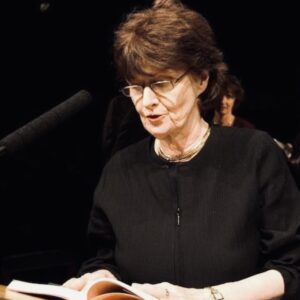 Eavan Boland Reading It's a Woman's World
Maud Gonne and Mother Ireland
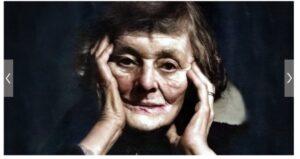 Maud Gonne in old age: a lifetime of political and social achievements
For after all she is a woman.... and however vile and selfish and pitiless her soul may be, she must sometimes tremble as death approaches when she thinks of the countless Irish mothers who, sheltering under the cloudy Irish sky, watching their little ones starve, have cursed her before they died.…Through her many collaborations with other activists, writers and orators, including the most famous of the many poets for whom she was a muse, her friend WB Yeats, Gonne not only embraced Mother Ireland, she embodied her, and she served her.
Eavan Boland and Mother Ireland
The poet Eavan Boland, on the other hand, critically examined the concept. In her essays and in her poetry, she challenged how such images and more generally "Irish poems simplified women From one of them
I learned my name.
I rose up. I remembered it.
Now I could tell my story.
It was different
from the story told about me."
Her approach was to demystify and reclaim the symbols and myths that define and restrict women's lives, by writing of how it actually felt to be herself, a woman, a writer, a mother, a resident of Dublin suburbia trying to reimagine what has been forever lost, what cannot be reclaimed because occluded by symbology and myth.
In this reimagining, and in her gender politics, she changed the scope and reach of Irish literature, immeasurably.
Eavan Boland's Mother and Maud Gonne
Side note: In my travels around these two women's lives this week, I found also a little story that connected their real lives... loosely. Maud Gonne had less than ten years to live when Eavan Boland was born. Boland's mother, the painter Frances Kelly, bridged the generations between them. Apparently Kelly once sought a painting commission from Maud Gonne and was invited to visit Roebuck House, Gonne's home in Dublin. While there, she noted the famous collection of caged birds and queried how Gonne, the fervent advocate for national freedom, could reconcile the irony of her strong libertarian principles with the act of keeping birds confined in cages. According to Jody Allen Randolph, Eavan Boland's biographer, she received neither an answer nor a commission.Two Women, Two Feminisms
The difference between Maud Gonne and Eavan Boland in relation to Mother Ireland and nationalist symbology, was a difference of character, as much as anything. Gonne had little time for analysis. She was a doer, whose forceful and activist personality drove her to adopt a glorifying view that aligned with her revolutionary ideals and her famously single-minded determination to defeat the British forces in Ireland. Boland was a thinker, whose introspective and questioning nature led her to critique and redefine the symbol, focusing on the nuanced and often problematic aspects of such idealizations, after the foundation of the partitioned Irish state. But the difference also relates to types of feminism and each represents an ongoing argument in women's studies. When Boland writes in her poem, "It's a Woman's World":...our windows moth our children to the flame of hearth not history,she's not writing of a woman like Maud Gonne, who definitely flamed the flame of history for her children, as for all others. She involved her apolitical daughter (most known as her niece or cousin in conservative Ireland) the Irish Civil War, and not only earmarked the role of "King of Ireland" for her son, Seán. She brought him into the Republican cause as a youth, supported his formation of an alternative political party in later life, and he has spoken of her influence in his co-founding of Amnesty International. Gonne's feminism was equality feminism--assertive, public, and directly engaged, calling on change that allowed women the same rights and opportunities as men, particularly in the spheres of voting and national independence. Gonne's work with the Daughters of Ireland (Inghinidhe na hÉireann), and The Mothers which she founded, aimed at mobilizing women for the national cause, but also emphasized the importance of women's roles in public and political life, advocating for equal participation in the struggle for Irish freedom. Boland's focussed on the undervalued aspects of women's lives, and interrogates the narratives, myths, and historical roles that have been imposed on women, aiming to reclaim and redefine women's roles. Different, they undoubtedly were but as two highly committed, feminist Irishwomen, what unites them is greater than what divides them. Both women shared a deep engagement with, and commitment to Ireland, its history, and its cultural identity, grounded in gender. Although their methods and focuses differed, each was an impassioned and influential activist who challenged the societal and cultural norms of their times and sought to redefine or question established narratives. Both were political and poetical, to varying degrees, and each used her unique voice to explore, express and address enduring gender questions from her own generational and ideological perspective. In doing so, they both greatly expanded what was possible for all Irish women, at home and abroad. We have much reason to admire, and be grateful, to them both. Support a statue of Maud Gonne for Dublin